
RAG: The Bridge Between LLM Power and Enterprise Trust
Discover how RAG architecture eliminates AI hallucinations by grounding LLMs in verifiable enterprise knowledge—without continuous retraining costs or operational complexity.
While competitors debate AI strategy, forward-thinking organizations are already deploying RAG architectures to ground powerful LLMs in verifiable enterprise knowledge—without the operational nightmare of continuous model retraining. The competitive window for early implementation is rapidly closing.
Why Your LLM Keeps Hallucinating (And How RAG Fixes It)
Your production LLM just confidently cited a product feature that doesn’t exist. Again. This isn’t a training problem—it’s an architecture problem. Large Language Models operate on fixed knowledge from their last training cycle, generating plausible but factually wrong responses when confronted with proprietary data or recent developments (Preprints.org, 2025).
Retrieval-Augmented Generation (RAG) solves this by grounding LLM responses in verifiable, real-time external knowledge rather than relying solely on pre-trained parameters. For technical leaders deploying enterprise AI, RAG represents the pragmatic path to production systems that maintain accuracy without continuous retraining costs.
The Architecture That Changes Everything
RAG integrates LLM generative capabilities with semantic retrieval from external knowledge sources through a three-stage pattern (Preprints.org, 2025):
- Retrieval: Neural retrievers identify relevant passages using dense similarity matching from vector databases
- Augmentation: Retrieved passages are concatenated with user queries
- Generation: The LLM conditions responses on this combined context
Critical distinction: RAG augments models with retrieved context at inference time rather than modifying the model itself. This preserves generative capabilities while injecting domain-specific knowledge exactly when needed (One2N Blog).
Enterprise-Critical Advantages
The hallucination problem has liability implications. When LLMs generate incorrect information in customer-facing applications or compliance documentation, the business risk is measurable. RAG directly addresses this by anchoring responses in verifiable source material (Prompt Engineering Guide).
Three competitive advantages:
- Fixed knowledge cutoffs disappear: Models access information from this morning’s database update, not last year’s training run (Walturn Insights)
- Proprietary knowledge becomes accessible: Private documentation and internal knowledge bases integrate without exposing training data (Coursera)
- Domain adaptation without retraining: Specialized fields gain LLM capabilities without million-dollar fine-tuning projects
Operational benefits include:
- Reduced hallucination rates through evidence-based generation
- Separated knowledge and model updates—refresh vector databases without retraining
- Lower total cost of ownership versus continuous model retraining
- Compliance-ready audit trails through source attribution
From Architecture to Advantage
RAG architecture solves the fundamental tension between LLM capabilities and enterprise reliability requirements—grounding generative power in verifiable knowledge without the operational burden of continuous retraining. For technical leaders moving beyond experimentation, the question isn’t whether to implement RAG, but how quickly your organization can operationalize it before competitors establish their advantage. At Meca, we’ve deployed 10+ production RAG systems that integrate seamlessly with existing knowledge infrastructure, transforming experimental AI projects into measurable business outcomes within weeks, not quarters. Let’s discuss how RAG fits your specific production requirements.
Related articles
Beyond Pilots: How Agentic AI Delivers Real ROI in Claims Processing
Discover how Allianz transformed claims handling with autonomous AI while 85% of insurers fail to achieve positive ROI. Learn the architecture behind production-grade agentic systems.
Autonomous AI: Your Unfair Operational Advantage Now
Market leaders are deploying autonomous agentic AI systems that transform operations from task automation to outcome ownership, creating strategic competitive advantages.
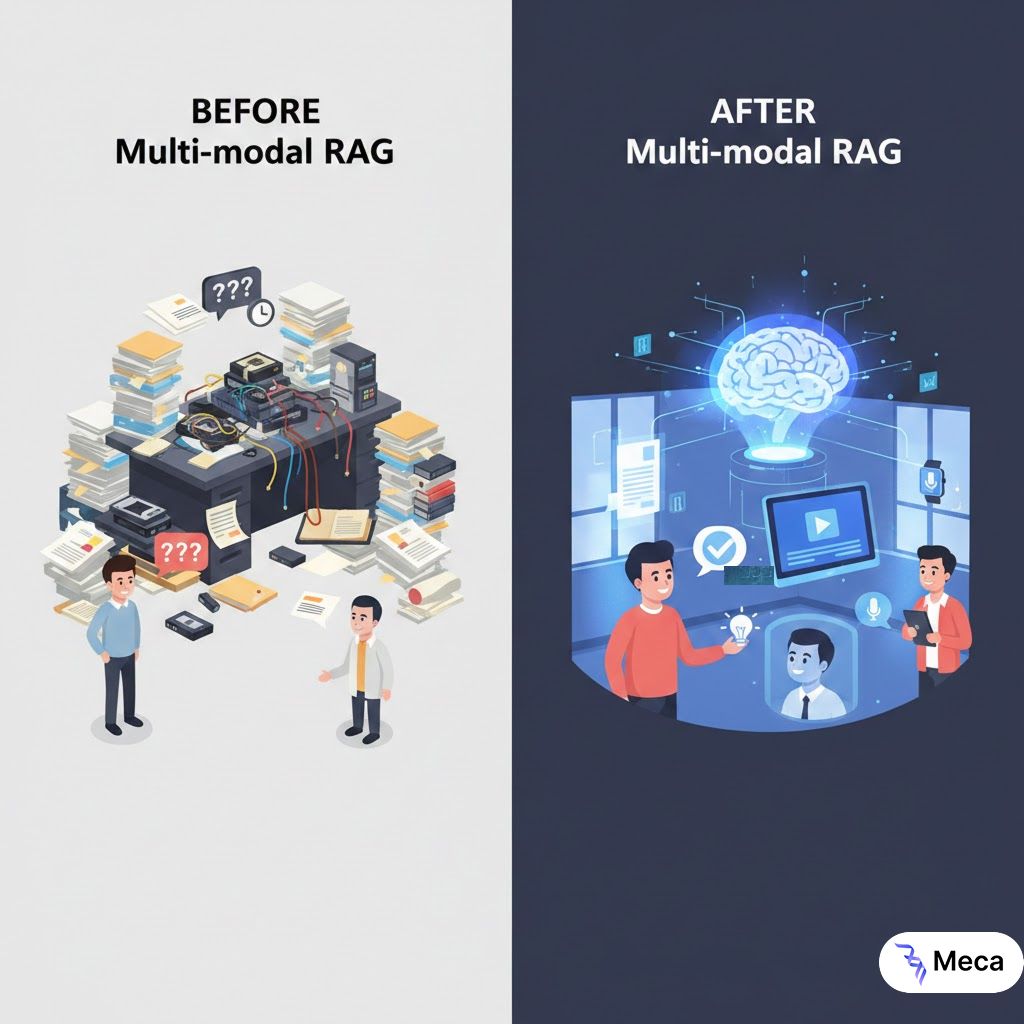
Cut Onboarding Time in Half with Multi-modal RAG Technology
Discover how multi-modal RAG technology transforms knowledge management across HR, sales, marketing, and technical teams by retrieving answers from thousands of documents. Dramatically reduce repetitive workload.